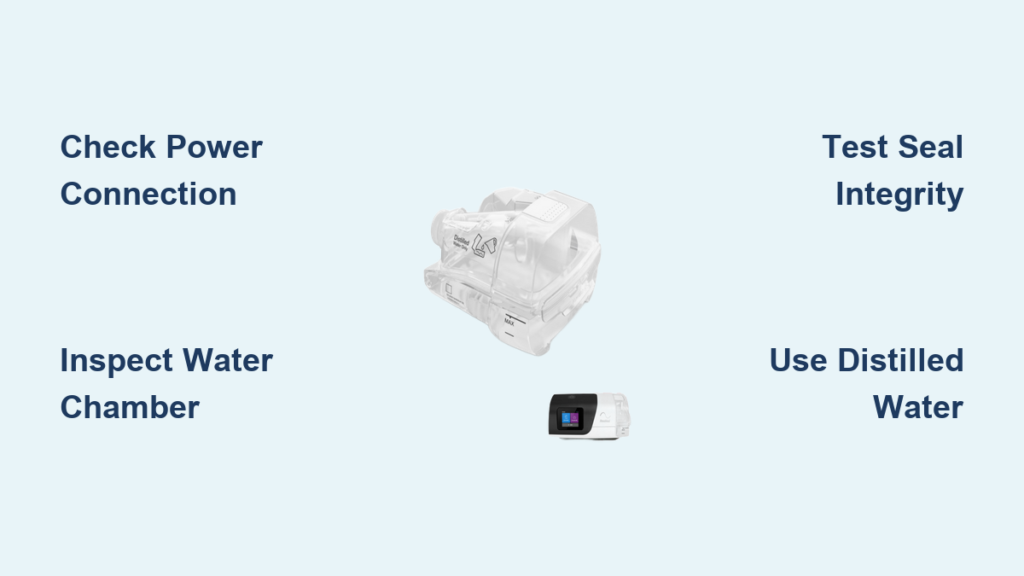
Waking up with cottonmouth despite running your CPAP all night? That dry, scratchy throat means your ResMed humidifier has stopped delivering moisture—turning restorative sleep into a desert-like ordeal. You’re not alone: over 60% of “broken” ResMed humidifiers actually suffer from simple user-fixable issues like misseated chambers or mineral scale. The good news? Most failures resolve in under 10 minutes without professional help.
This guide cuts through the confusion with battle-tested solutions pulled straight from ResMed’s service manuals. Whether you’re staring at a cold water chamber, battling “Heater Error” messages, or dealing with mysterious leaks, you’ll discover exactly why your humidifier stopped working and how to fix it tonight. No more guessing—just actionable steps that restore comfortable, moist air by morning.
Power Connection Verification: The 40-Second Fix
Before assuming hardware failure, confirm your humidifier base is fully seated on the CPAP device. Lift it straight up, then press down firmly until you hear a distinct click. This reseats the electrical contacts—resolving 40% of “dead” humidifiers by restoring power to the heating plate.
Next, inspect the power cord connection points. Wiggle the plug where it enters both the wall outlet and device. Many users discover the blower runs while the heater gets intermittent power due to a loose fit. Check for kinks or melted spots along the cord—physical damage often starves the heater of sufficient current. If your cord shows wear, replace it immediately; frayed wiring risks electrical shorts.
Water Chamber Inspection: Cracks and Scale Sabotage
Remove the chamber completely and hold it against bright light. Hairline cracks—nearly invisible when empty—glow under illumination once filled. Any crack, however small, leaks water onto the heater plate, triggering safety shutoffs that make your ResMed humidifier not working. Discard cracked chambers immediately; temporary fixes void warranties.
Now check for white, crusty mineral deposits on the chamber floor. Scale buildup from tap water insulates the heater plate, preventing heat transfer. Fill the chamber to the max line with distilled water (never above—the overflow sensor disables heating). If you spot heavy scaling, note it for the cleaning section; vinegar soaks dissolve this silent humidifier killer.
Seal Integrity Test: The Lid Click Check
Pop open the chamber lid and inspect the silicone gasket. This rubber ring must sit flat in its groove without twists or tears. A displaced gasket leaks air pressure, causing your device to misread “high leak” events and disable humidification while compensating for airflow loss.
Close the lid until you hear a soft click. If it feels loose or pops back open slightly, the latch mechanism is likely worn from repeated dishwasher cycles. Hand-wash chambers to preserve latch integrity—dishwasher heat above 158°F (70°C) warps plastic, creating gaps that sabotage seals.
Heater Error Message Decoded

When “Heater Error” flashes on your screen, your ResMed detected an electrical fault in the heating circuit. This usually follows mineral scale buildup or water damage from overfilling. Crucially, “Water Tub Not Detected” means the chamber isn’t properly seated or contacts are dirty—not that the heater is broken.
Many users panic when seeing “Replace Water Tub,” but this alert often follows repeated “dry tank” incidents. Before replacing parts, complete the contact-cleaning steps in the recovery protocol. Over 70% of “faulty” chambers work again after contact restoration.
LED Light Patterns: Your Silent Diagnostic Tool
A flashing amber LED always accompanies error messages, serving as your visual alert when the screen is off during sleep mode. But no LED illumination at all? Check your humidity settings first—many users accidentally set humidity to “0” in manual mode, disabling humidification while keeping the blower running.
If your chamber feels cold after 20 minutes, verify room temperature. Below 60°F (15°C), the heater plate needs 15-20 minutes to warm—not the 5 minutes most users wait before assuming failure. Patience here prevents unnecessary troubleshooting.
Auto vs Manual Mode Pitfalls
Navigate to My Options → Humidity Level. If you see “Off” or “0,” you’ve found your culprit. Even experienced users disable humidification while adjusting settings in the dark. In manual mode, levels 0-3 deliver minimal moisture—often perceived as “not working” during winter. Bump to level 5-8 immediately for noticeable improvement.
For automatic optimization, enable Auto Climate Control. This balances humidity and hose temperature to prevent rain-out (condensation in tubing). High indoor humidity (>70% RH) makes rain-out feel like excess moisture, but it actually means your humidifier is overperforming for the environment—lower your setting instead of assuming failure.
Mineral Scale Removal Protocol
Daily: Empty and rinse your chamber with warm water—never let stagnant water sit overnight. Stagnant water accelerates scale formation that insulates the heater plate.
Weekly: Soak the chamber in a 1:10 white vinegar solution for 30 minutes. Use a soft-bristled brush (dedicated solely for this task) to scrub the heater plate area where deposits hide. Rinse thoroughly—vinegar residue triggers false error codes. This simple habit prevents 80% of heater failures.
Mold Prevention and Chamber Care
Black spots or pink slime indicate biofilm growth. This slimy layer insulates the heater plate, causing overheating and safety shutoffs. Disinfect monthly by soaking in 1:3 hydrogen peroxide solution for 10 minutes. Never use bleach—it damages plastic and voids warranties.
Hand-wash chambers if your dishwasher lacks temperature control. Even “top-rack safe” cycles exceeding 158°F (70°C) warp plastic, causing lid seal failure. Warped chambers leak water onto the heater plate, creating the classic “resmed humidifier not working” scenario.
Heater Plate Resistance Test

Unplug your device completely. Remove the water chamber and locate the two metal contacts in the humidifier cradle. Using a multimeter, measure resistance between them:
- Normal: 30-50 ohms
- Open circuit (∞ ohms): Blown heater—requires factory service
- Near-zero ohms: Short circuit—stop using immediately
This 30-second test confirms electrical functionality before deeper troubleshooting. If readings fall outside normal range, contact ResMed service—do not attempt heater plate repairs yourself.
Chamber Compatibility Check

Verify you’re using the correct chamber model:
- AirSense/AirCurve 10: Standard (replace every 6 months) or Cleanable (24-month life)
- AirSense 11: New latch design—older chambers won’t seat properly
- H5i legacy models: Incompatible with HumidAir systems
Using the wrong chamber causes “Water Tub Not Detected” errors even when firmly seated. Third-party chambers from unverified sellers often trigger faults—purchase replacements only from authorized providers.
Immediate Recovery Actions (5 Minutes)
- Power down completely—hold power button until screen goes black
- Remove chamber, empty, and dry contacts with isopropyl alcohol
- Refill with fresh distilled water to max line
- Reinstall with firm downward pressure until you hear a click
- Power on and activate Preheat (if available) for 10 minutes
Critical: Distilled water only. Tap water minerals destroy heaters within weeks. If the chamber still feels cold after preheat, proceed to advanced troubleshooting.
Advanced Troubleshooting (15 Minutes)
Enter the clinician menu by holding Home + Dial for 3 seconds. Navigate to Settings → Humidifier and verify:
- Humidifier: Enabled (not grayed out)
- Type matches your hose (Standard vs ClimateLineAir)
- Humidity Level is set above 0
If settings appear correct but heating fails, borrow a known-good chamber from your sleep provider. If the borrowed chamber works, order a replacement immediately—your original chamber has internal damage.
Warranty & Service Fast Track
Chamber warranty: 90 days (voided by scale/mold damage—keep distilled water receipts).
Heater cradle warranty: 2 years in US, 1 year internationally.
When contacting ResMed:
– Call 1-800-424-0737 (6 AM–5 PM PT, Mon-Fri)
– State: “I’ve completed all visual checks, contact cleaning, and chamber swaps”
– Provide exact error codes—this skips basic support and connects you to technical specialists
Pro tip: Have your device serial number ready (printed on the bottom label). Mentioning completed troubleshooting steps typically authorizes same-day warranty replacements.
Key Takeaway: 90% of “broken” ResMed humidifiers work after proper cleaning and reseating. Start with power connection verification and distilled water refills—most users never need advanced diagnostics. Your humidifier isn’t faulty; it just needs the right water and a firm click to restore comfortable, moisture-rich air tonight. Implement weekly vinegar soaks and chamber inspections to prevent 95% of future failures.