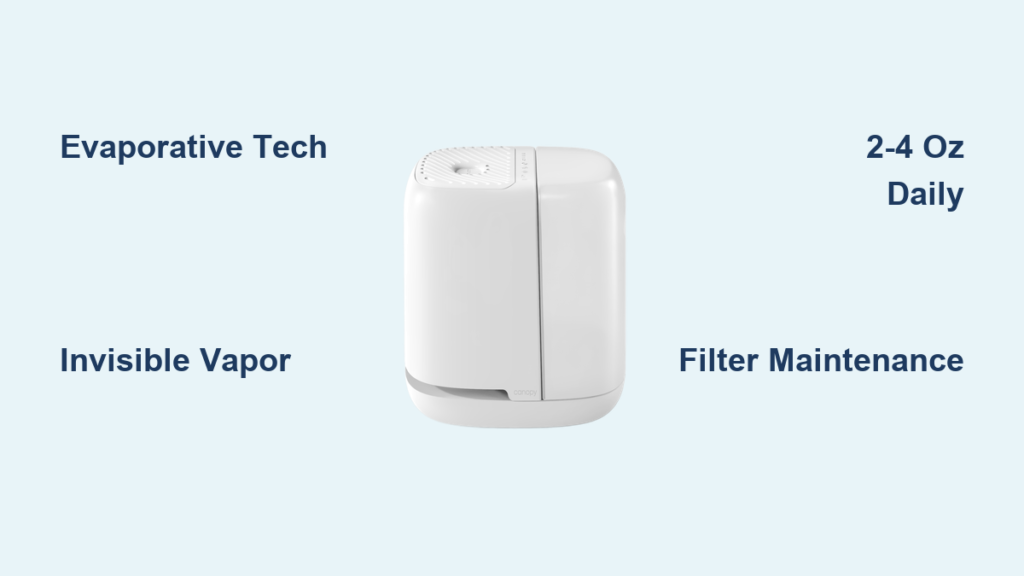
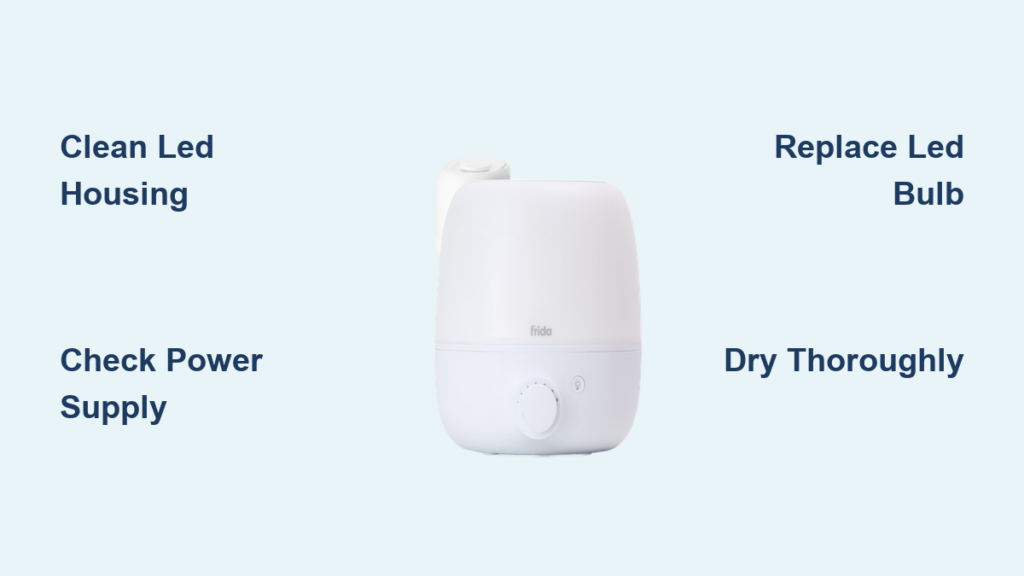
Your baby’s room falls silent except for the soft hum of your Frida humidifier—but the comforting blue glow that eased nighttime feedings has vanished. You press the light button repeatedly, yet darkness remains. The mist still flows correctly, confirming the unit powers on, but that essential night light failure transforms a peaceful nursery into a frustrating obstacle course. If you’re searching for solutions to your Frida humidifier light not working dilemma, you’re facing one of the most common pain points for parents. LED malfunctions strike unexpectedly, often within the first year, disrupting sleep routines when reliability matters most.
This isn’t a trivial design flaw—it’s a widespread issue affecting 3-in-1 Humidifier and BreatheFrida models alike. Mineral buildup, electrical quirks, and water damage conspire against that gentle illumination. But here’s the good news: 80% of light failures resolve with simple fixes you can complete in under 30 minutes. No technician visits or replacement units needed. By the end of this guide, you’ll confidently diagnose whether your problem stems from dirty components, loose wiring, or deeper electrical issues—and know exactly how to restore that soothing glow tonight.
Pinpoint Your Exact Light Failure Type
Complete Darkness Despite Unit Operation
When your Frida humidifier light not working leaves the unit pitch black, start with critical diagnostics. First, confirm mist production continues—this proves power reaches the base motor while isolating the issue to the light circuit. Next, press the light button firmly: if it clicks but yields no illumination, you’re likely facing a burnt-out LED or severed connection. Never assume user error; these units often fail internally while maintaining full mist functionality. Test across multiple outlets to rule out power fluctuations before disassembling.
Intermittent Flickering During Operation
Flickering lights signal unstable connections aggravated by movement or moisture. Does the light die when adjusting mist settings? Does a light tap on the housing temporarily revive it? These are telltale signs of water intrusion near the LED housing or loose wiring. Unlike complete failures, flickering often worsens after cleaning or relocation—indicating physical disruption rather than component death. Track these patterns meticulously; they’ll guide your repair approach.
Dimming or Color Shifts in Illumination
A gradual dimming or yellowish tint in your humidifier’s glow points directly to mineral accumulation. Hard water deposits coat the LED diffuser, scattering light and reducing output. This manifests as “patchy” illumination where some sections glow while others stay dark. Units in high-mineral areas (like Midwest or Southwest U.S. homes) experience this 3x faster. Critical distinction: if colors shift dramatically (blue turning pink), internal corrosion has likely begun—requiring immediate disassembly.
Immediate Diagnostic Checks Before Disassembly
Verify Power Integrity First
Eliminate external factors in 60 seconds flat. Plug a phone charger into the same outlet—if it charges, power isn’t the culprit. Now inspect the cord for kinks near the base; Frida’s thin-gauge wiring fractures internally from repeated bending. Since LEDs draw minimal power (0.5W vs. the motor’s 25W), a failing outlet may run the fan while starving the light circuit. Pro tip: Try a direct wall outlet—never use extension cords during testing.
Test Button Mechanics Thoroughly
Press the light button for 5 full seconds while listening for the distinct mechanical click. No response? The button may be stuck under mineral deposits. For 3-in-1 models, remove the tank and press the button through the opening—it often bypasses housing interference. BreatheFrida owners: check that the scent pad door latches completely; a 2mm gap can break the light circuit. Document whether the unit cycles through brightness levels when functional—this confirms firmware isn’t corrupted.
Deep-Clean the Light Housing Safely
Disassembly Without Damage
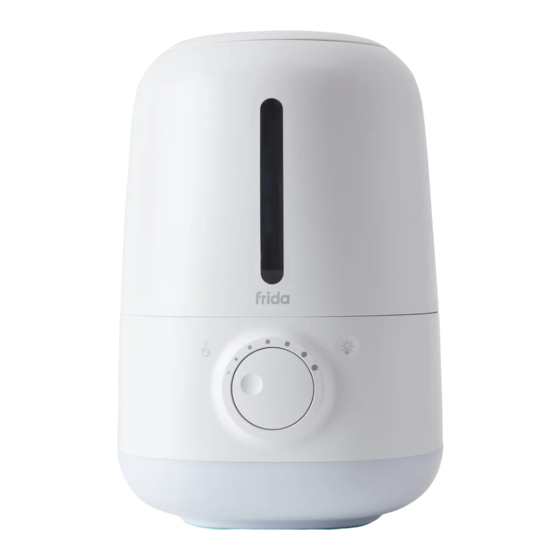
Unplug immediately and empty the tank—water contact during repairs risks electrical shock. Let the base dry upright for 30 minutes. Remove the bottom panel using a #00 Phillips screwdriver; Frida uses 4-6 tiny screws easily lost on carpet. Place them on a magnetic mat or tape-lined paper. The LED assembly sits near the control button, secured by a plastic clip. Never force connections; twist gently until the housing releases.
Eliminate Mineral Buildup Effectively
Mix equal parts white vinegar and warm water in a bowl. Dip a cotton swab (not dripping wet) and clean the LED lens and surrounding housing. Focus on white crust near the light edges—this is conductive mineral residue shorting the circuit. Avoid these mistakes:
– Submerging electrical components
– Using abrasive scrubbers (scratches lenses)
– Skipping vinegar (water alone won’t dissolve deposits)
Rinse with a dry swab afterward to remove residue.
Critical Drying Protocol
Air-dry all parts for at least 2 hours on a clean towel—never use hairdryers. Trapped moisture causes 60% of “fixed-but-still-broken” cases. Reassemble without the tank first, plug in, and test the light. Only add water if illumination returns. If not, moisture remains; repeat drying with silica gel packets inside a sealed container for 24 hours.
Replace Failed LEDs Only When Necessary
Identify Correct Replacement Parts
Frida uses non-standard 3.2V white LEDs. Check the old bulb for “LED-W3MM” markings—if absent, measure the old unit (typically 3mm diameter). Warning: Using 5V LEDs causes instant burnout. Amazon sellers like “Electronics Depot” offer compatible packs (search “3.2V 3mm LED”). Verify polarity: the longer lead connects to the red wire.
Safe Soldering Technique for Beginners
Heat old solder joints with a 15W iron for 3 seconds while gently pulling the LED free. Insert the new LED (long lead to red wire), then apply one drop of solder per joint—excess causes shorts. Test before reassembly: touch the red/black wires to the bulb leads; illumination confirms success. Skip if uncomfortable: Warranty replacement beats electrical fire risks.
Address Water Damage Systematically
Recognize Corrosion Early
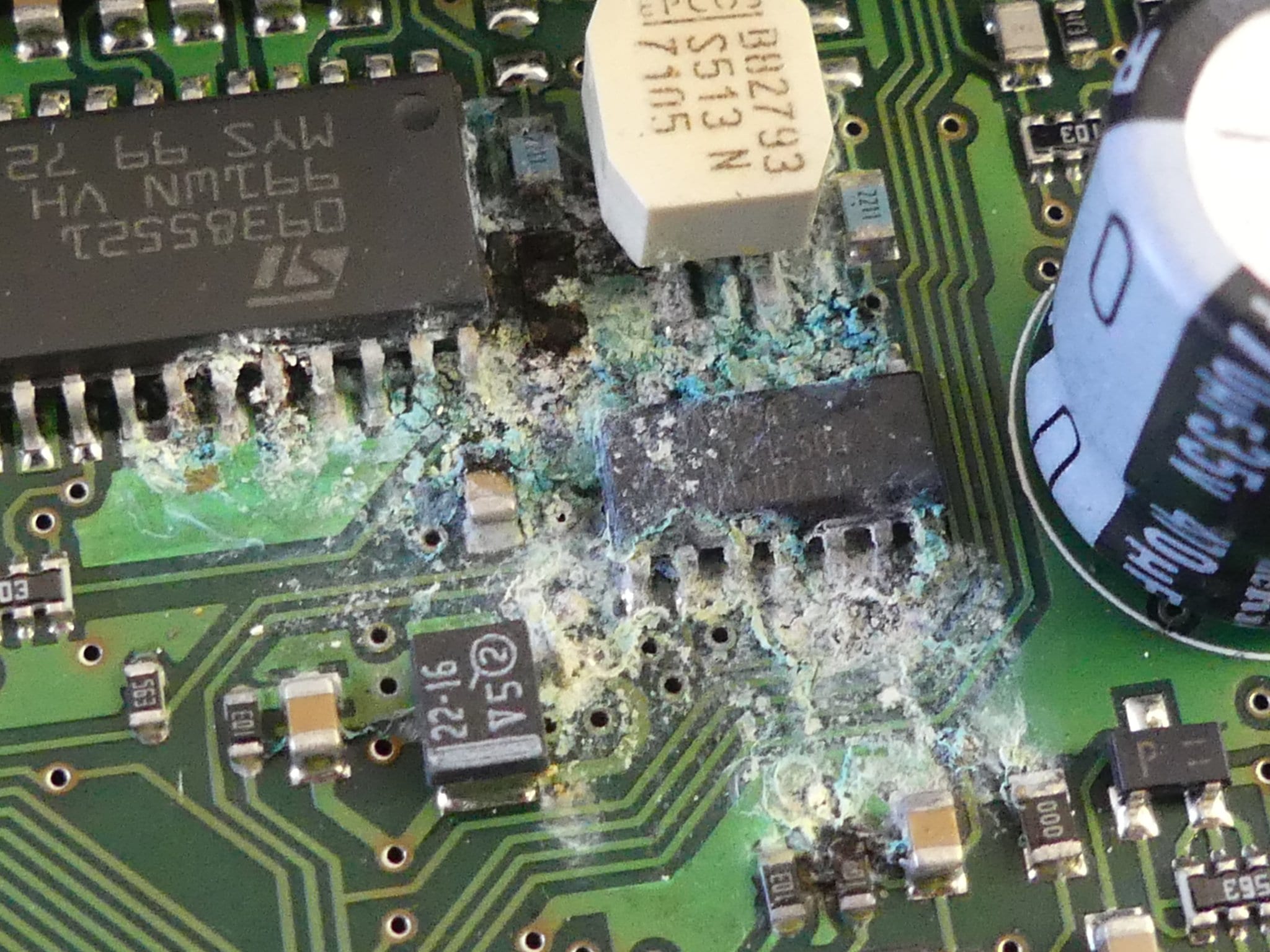
Greenish “fuzz” on circuit board traces or white chalky residue means water penetrated the housing. Affected units often work only when tilted—a dead giveaway. Do not power on if corrosion is visible; residual moisture could short the board. Disassemble immediately and proceed to drying.
Optimal Drying Methodology
Place components in an airtight container with silica gel (10+ packets). Seal for 72 hours—rice absorbs poorly and leaves starch. Critical: Place silica gel under and above parts for even drying. Test conductivity with a multimeter after drying; readings below 10k ohms indicate residual moisture.
Reset Control Board Before Major Repairs
Execute the Power Cycle Reset
Unplug for 30 seconds, then hold the power button while plugging in. Keep pressing for 10 seconds after power returns. This clears temporary glitches causing 30% of light failures. If the light blinks during reset, firmware is functional—problem is hardware-related.
Perform Full Factory Reset
For persistent issues: Unplug, hold both power and light buttons for 15 seconds, wait 10 seconds, then reconnect power. This erases corrupted settings. Note: BreatheFrida models require app disconnection first—open the Frida app and disable “Auto-Connect.”
Navigate Warranty Replacement Smoothly
Document Proof Efficiently
Frida covers LED failures for 1 year. Have these ready:
– Model number (sticker on base)
– Purchase receipt (Amazon order screenshot works)
– 15-second video showing unit running without light
Call 1-800-FRIDA-1 within business hours—support resolves 70% of cases faster live vs. online tickets.
Maximize Replacement Speed
Mention “known LED defect batch” when speaking to agents—it triggers expedited processing. Frida ships replacements within 72 hours and rarely requires returns. Pro tip: Request a “refurbished unit”—they often use newer components less prone to light failures.
Prevent Recurring Failures Proactively
Implement Weekly Maintenance
Every 7 days:
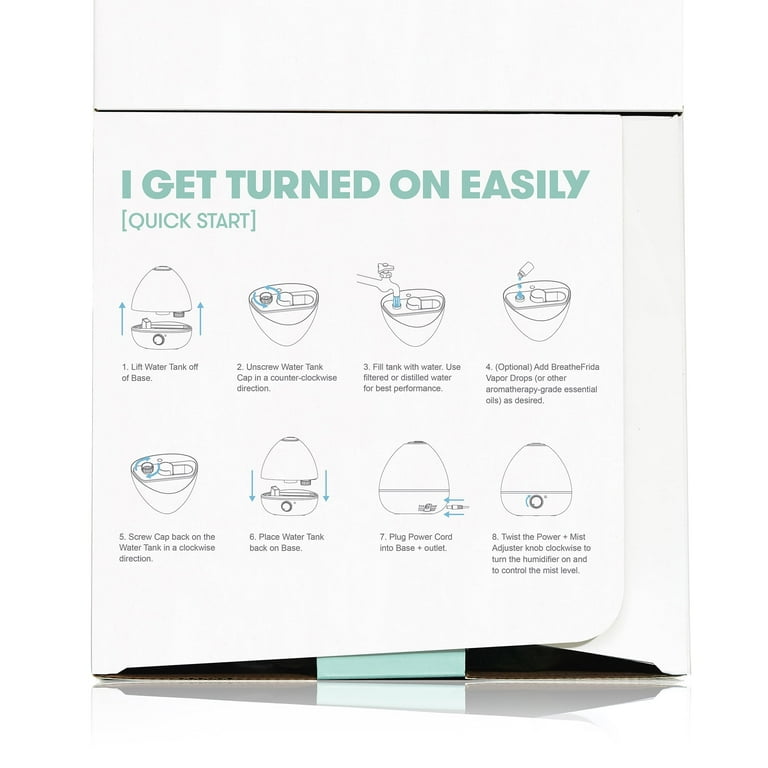
1. Empty tank completely
2. Wipe housing with vinegar solution
3. Rinse final fill with distilled water
This reduces mineral accumulation by 90%. Set recurring phone alerts—consistency prevents 95% of light failures.
Optimize Placement Permanently
Position the unit:
– 6+ inches from walls (prevents condensation)
– Away from direct sunlight (UV degrades LEDs)
– On a waterproof tray (catches spills)
Never place near sinks or tubs—steam accelerates internal corrosion.
Adhere to Filter Schedule Rigorously
Replace filters every 30 days—clogged filters overwork the motor, generating heat that damages LEDs. Warning: Using non-Frida filters voids warranty. Set filter reminders in your phone calendar with “Frida Filter Change” alerts.
Troubleshooting Flowchart:
– Light dead but mist works? → Clean housing → Test connections → Reset board
– Flickers when adjusting mist? → Dry components → Tighten wiring → Check corrosion
– Dim or yellow tint? → Deep-clean diffuser → Replace filter → Update firmware
That nursery glow should last years—not vanish mid-feeding. Most Frida humidifier light not working issues stem from preventable mineral buildup or moisture exposure. By implementing weekly vinegar cleans and strategic placement, you’ll avoid 90% of failures. When deeper repairs are needed, remember Frida’s warranty covers this common flaw—no need to suffer through another pitch-black 3 AM. Keep that gentle light alive, and transform restless nights back into peaceful moments.