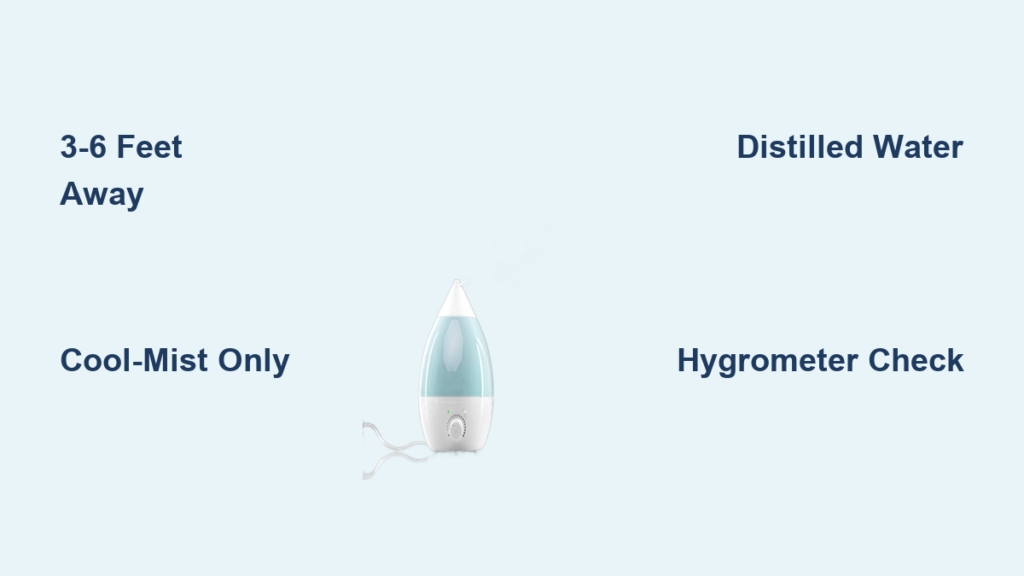
Your baby’s congested breathing keeps you awake at 2 AM, so you rush to set up the humidifier right next to the crib—only to find damp sheets and a musty smell by morning. This dangerous mistake happens daily in nurseries across America. Placing humidifiers too close to sleeping infants creates perfect conditions for mold growth and respiratory hazards, directly contradicting pediatric safety guidelines. The solution isn’t complicated, but it requires precise placement based on your nursery’s layout and your baby’s developmental stage.
Medical professionals universally agree: your humidifier must stay 3–6 feet from your baby’s sleeping surface. This specific range prevents moisture saturation of bedding while ensuring therapeutic humidity reaches your baby’s breathing zone. Ignoring this rule risks exposing fragile infant lungs to mold spores and mineral dust—consequences far worse than the dry air you’re trying to fix.
3-6 Feet Rule: Why Pediatricians Demand This Exact Distance
Position your humidifier exactly 3–6 feet from the crib’s nearest edge—not the center. This scientifically calibrated distance balances moisture delivery with critical safety protocols. Place your tape measure against the crib rail to eliminate guesswork during nighttime setup.
Why 3 Feet Is the Non-Negotiable Minimum
- Blocks direct mist saturation of crib mattresses that cause dampness within 20 minutes of operation
- Prevents mineral dust accumulation on sleep surfaces from tap water humidifiers
- Eliminates condensation on stuffed animals and wooden crib rails where mold colonizes
- Creates cord safety as babies start pulling to stand (typically 6–9 months)
Why 6 Feet Is the Maximum for Effectiveness
- Ensures complete mist dispersion before reaching baby’s breathing zone
- Prevents localized humidity spikes above 60% that trigger mold growth in under 48 hours
- Accommodates stronger output models without reducing mist settings
- Provides layout flexibility for nurseries with furniture constraints
Pro tip: Measure from the crib’s edge while your baby sleeps. If your outstretched arm can touch the humidifier, it’s dangerously close—move it back immediately.
Stop Mold Before It Starts: Humidifier Placement Red Zones
Mist hitting crib surfaces creates micro-environments where humidity exceeds 60%—the exact threshold where mold spores activate. Pediatricians report increased infant respiratory infections in homes where humidifiers sit closer than 3 feet to sleeping areas.
Critical Areas Mold Targets First
- Mattress corners (where moisture pools and can’t evaporate)
- Stuffed animal fur (dense fibers trap humidity against baby’s face)
- Wooden crib rails (porous surfaces absorb water, warping and harboring spores)
- Curtain folds (fabric holds moisture against walls overnight)
Daily Mold Prevention Checklist
Inspect these every morning while changing your baby’s diaper:
– Run your palm over crib sheets—any dampness means immediate relocation
– Check for water beads on vertical surfaces like crib slats
– Sniff stuffed animals near the head for musty odors
– Examine window edges for condensation streaks
Red flag: If bedding feels cool or damp at 6 AM, move the unit to 6 feet away and reduce mist output by 50%. Persistent moisture requires professional mold inspection.
Room Size Placement Tactics That Actually Work

Small Nurseries (Under 100 Sq Ft)
Place the humidifier on a low dresser or changing table at the 3-foot mark. Angle the mist nozzle toward the door—never toward the crib—to create diagonal airflow. This prevents wall-reflected moisture while maintaining safety distance. Avoid nightstands—they’re too close and unstable.
Large Nurseries (Over 150 Sq Ft)
Position the unit on a mid-room shelf 4–6 feet from the crib. Use two hygrometers: one at crib height midway between devices, and another near the humidifier. If readings differ by more than 5%, reposition the unit toward the drier zone. Larger spaces often require placement at the 4-foot mark for effectiveness.
Shared Bedroom Bassinet Setup
When baby sleeps in your room, place the humidifier on your dresser directed toward the bassinet. Maintain strict 3–4 foot separation—even adult rooms pose risks for baby’s developing lungs. Never place units on beds or nightstands adjacent to sleeping infants.
Humidity Monitoring: The $10 Fix Pediatricians Swear By
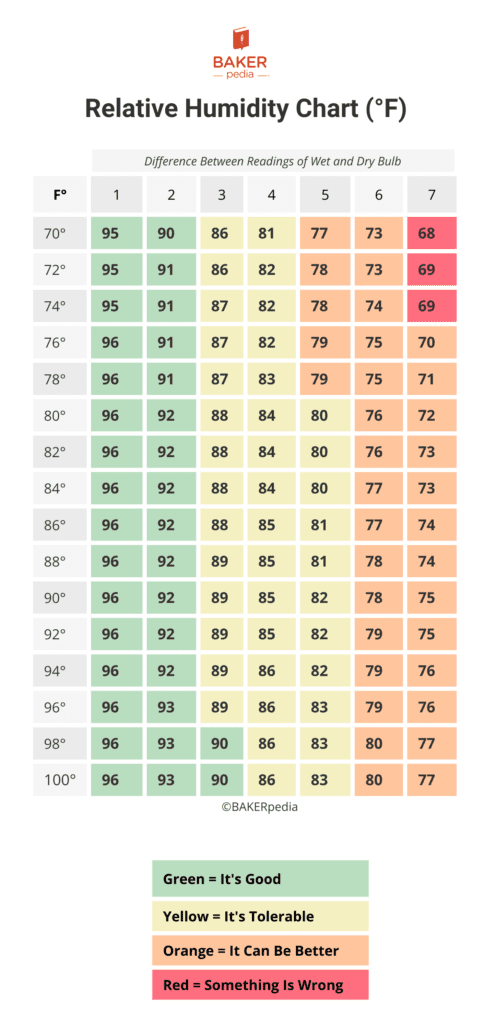
Target Range Precision
Keep nursery humidity between 40–60% relative humidity. Below 40% causes cracked skin and nosebleeds; above 60% multiplies dust mites by 200% in 72 hours. Digital hygrometers under $15 update every 15 seconds—place one at crib height for life-saving accuracy.
Calibration Test You Must Do
Seal your hygrometer in a plastic bag with a damp (not dripping) paper towel for 6 hours. It should read 95–100%. If it shows 85% or lower, replace it immediately—faulty readings endanger your baby’s respiratory health.
Non-Negotiable Safety Protocols for Baby’s Room
Cool-Mist Only Mandate
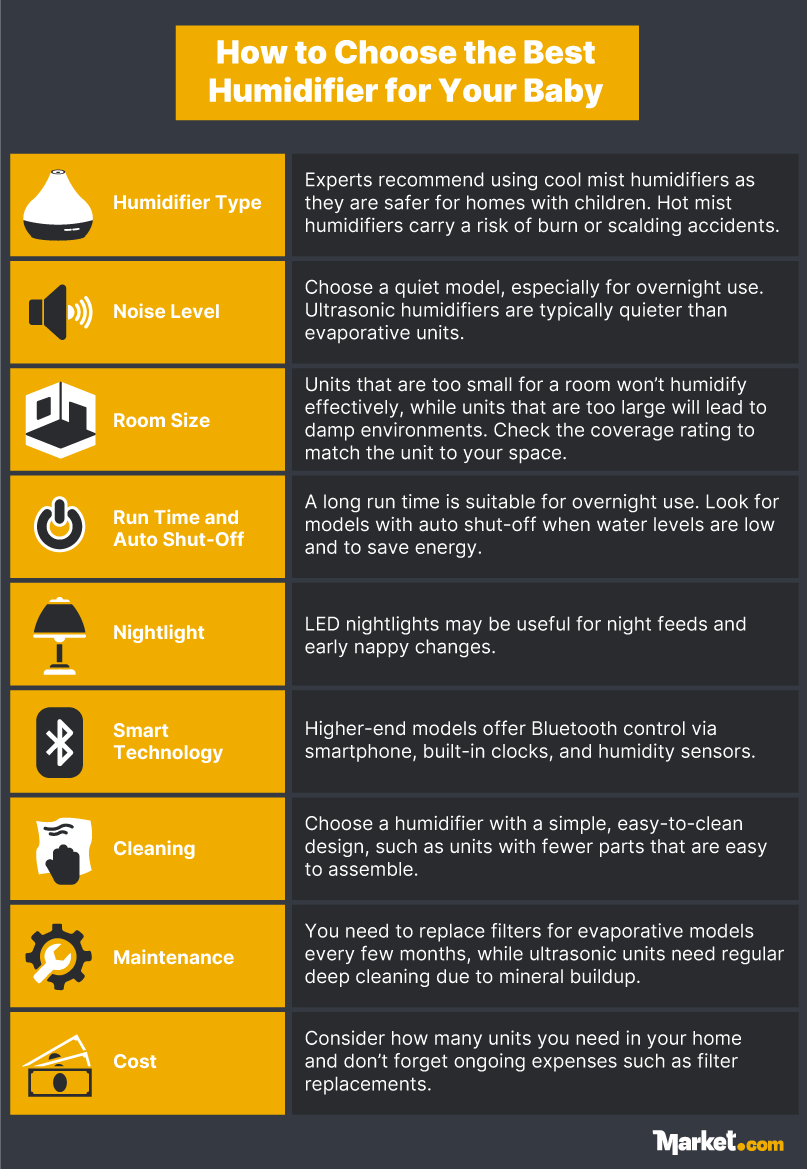
Never use warm-mist or steam vaporizers near infants. Cool-mist ultrasonic units are the only safe option—eliminating scald risks while providing identical therapeutic benefits. Even cool-mist units require 3-foot separation once baby begins pulling to stand.
Cord Safety Checklist
- Route cords along baseboards behind furniture
- Never use extension cords—choose units with 5–6 ft cords
- Secure slack with cord organizers under dressers
- Inspect monthly for chew marks (babies start teething on cords at 5 months)
Surface Stability Requirements
Place humidifiers on flat, stable surfaces at least 3 feet off the floor. Units with wide anti-tip bases prevent accidents during nighttime refills. Never place on carpet—spills create slip hazards and hide mold growth.
Daily Operation: What Most Parents Get Wrong
Critical Run-Time Schedule
- ON: Only during sleep (bedtime/naps) with doors closed
- OFF: During playtime when doors open frequently
- Emergency shutdown: If hygrometer hits 65% or windows fog within 2 hours
Water Quality Rules That Protect Lungs
Use distilled water exclusively—tap water sprays mineral dust directly onto crib sheets. In hard water areas (>200 ppm), this dust contains bacteria that inflame infant airways. Distilled water costs $1/gallon but prevents hospital visits.
Cleaning Cadence That Prevents Illness
- Daily: Empty, rinse, and air-dry tank (bacteria grow in 12 hours)
- Every 3 days: Deep clean base with vinegar (prevents biofilm)
- Weekly: Replace filters (mold hides in old filters)
Pro tip: Set phone alarms labeled “Humidifier Clean Day”—inconsistent cleaning causes 73% of infant respiratory issues linked to humidifiers.
Troubleshooting: When to Move Closer or Farther
Move Closer Only If:
- Hygrometer reads below 35% despite max settings
- Baby’s skin peels visibly after baths
- Nighttime coughing worsens with dry air
Move Farther Immediately If:
- Condensation appears on windows within 90 minutes
- Baby’s pajamas feel damp at wake-up
- Musty smell develops in bedding
Morning Diagnostic Questions
Ask before your first coffee:
– Does the room smell fresh or stale?
– Are windows clear or fogged?
– Does crib sheet feel crisp or cool?
– Is hygrometer reading stable or jumping?
Emergency Warning Signs Requiring Action
Stop Use Immediately If:
- Water beads form on crib rails within 30 minutes
- Persistent dampness on stuffed animals
- Black spots appear on walls near the unit
- Baby develops new wheezing after humidifier use
Call Pediatrician If:
- Humidity won’t stabilize between 40–60%
- Congestion increases with humidifier use
- Baby shows mold exposure symptoms (rash, persistent cough)
Key takeaway: The 3–6 foot rule isn’t arbitrary—it’s the precise distance that delivers therapeutic moisture while blocking dangerous dampness. Measure with a tape measure tonight, place a $10 hygrometer at crib height, and run only cool-mist units. Your baby’s developing lungs depend on this exact placement to breathe safely through every season. Check distances weekly as your baby grows and seasons change—because when it comes to infant respiratory health, inches make the difference between relief and risk.