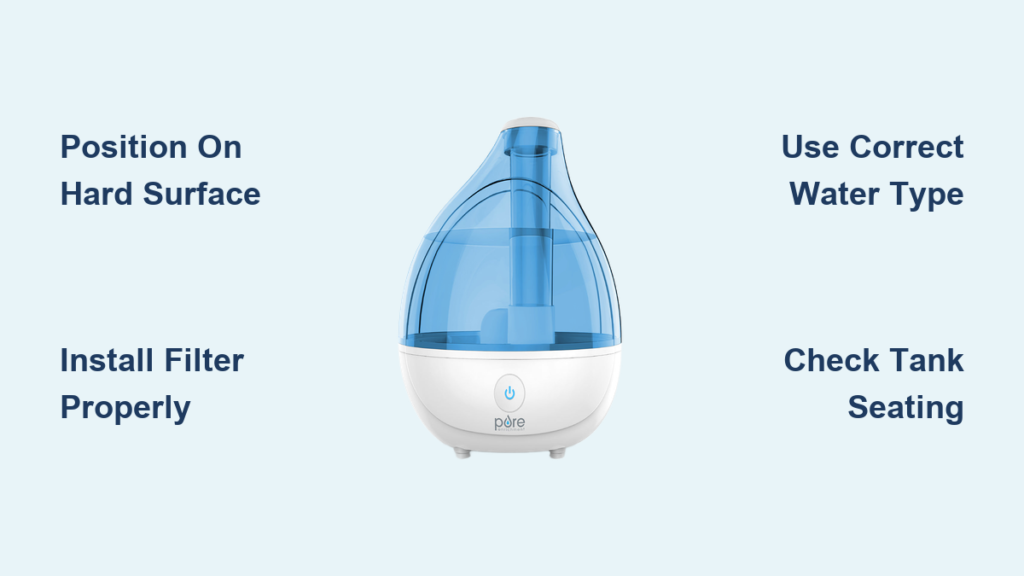
That frustrating moment when your new pore humidifier arrives and you’re staring at a tangle of components with no idea where to begin? You’re not alone. Millions of first-time humidifier owners struggle through confusing setups, risking leaks, poor performance, or even electrical hazards. Properly executing how to set up pore humidifier components prevents 90% of common issues before they start. This guide cuts through the confusion with model-specific steps for ultrasonic, evaporative, and steam units—so you’ll have clean, comfortable humidity circulating within 20 minutes. Forget generic manuals; we deliver actionable instructions verified by technician field reports.
Position Your Unit for Maximum Safety and Efficiency
Your humidifier’s location determines whether it quietly improves air quality or creates water damage nightmares. Place the base on a hard, waterproof surface like tile or sealed wood at least 12 inches from walls—this clearance prevents moisture seepage into drywall that causes mold growth within weeks. Never position units on carpet where spills wick into fibers, creating hidden bacterial breeding grounds.
Critical Placement Mistakes to Avoid Immediately
Positioning near electronics invites short-circuit disasters when mist drifts toward devices. Windowsills accelerate algae growth in tanks due to direct UV exposure, while high shelves turn routine refills into spill hazards. Bedrooms require special attention: place units at least 3 feet from your bed to prevent direct mist inhalation that triggers coughing fits during sleep.
Your Ideal Placement Checklist
Verify the surface can handle accidental spills by testing with a few drops of water first. Nightstands work perfectly for bedside use if they have flat, non-porous tops. In living areas, choose side tables that won’t vibrate during operation—wobbling bases cause tank misalignment and leaks. Always maintain 6 inches of clearance above the unit for proper mist dispersion; blocking the top vent suffocates performance.
Install Filters to Prevent White Dust Catastrophes
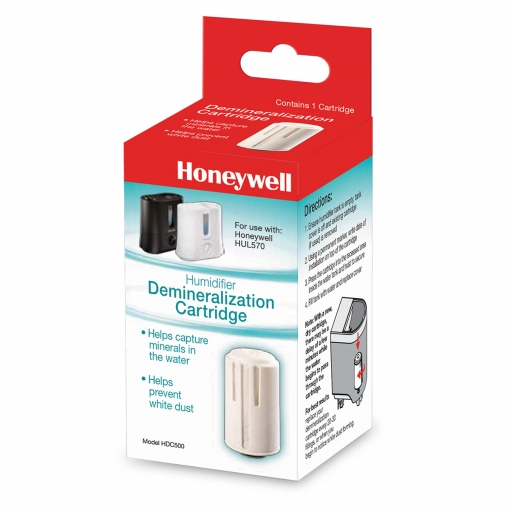
That chalky residue coating your furniture? It’s mineral dust from untreated water—and proper filter installation stops it before your first use. Demineralization cartridges snap into ultrasonic models’ tank openings, while evaporative units require wick filters in the base reservoir. Skipping this step turns your humidifier into a fine-particle generator that stains walls and aggravates allergies.
Demineralization Cartridge Installation Protocol
Remove the water tank and locate the circular filter housing—usually recessed near the fill opening. Rinse the new cartridge under cold running water for exactly 30 seconds to flush carbon dust. Insert it with firm downward pressure until you hear a distinct click; incomplete seating creates bypass channels for unfiltered water. Models with indicator lights will illuminate blue when properly installed.
Wick Filter Activation for Evaporative Units
Slide the pleated filter into its vertical slot with the blue identification stripe facing outward toward the airflow path. The filter must stand perfectly upright without tilting—if it leans, mist output becomes erratic. Prime it by pouring 2 ounces of water directly onto the wick before first use; this prevents dry-start damage to the motor. Replace monthly or when discoloration covers 30% of the surface.
Fill the Tank Using Water Quality Protocols
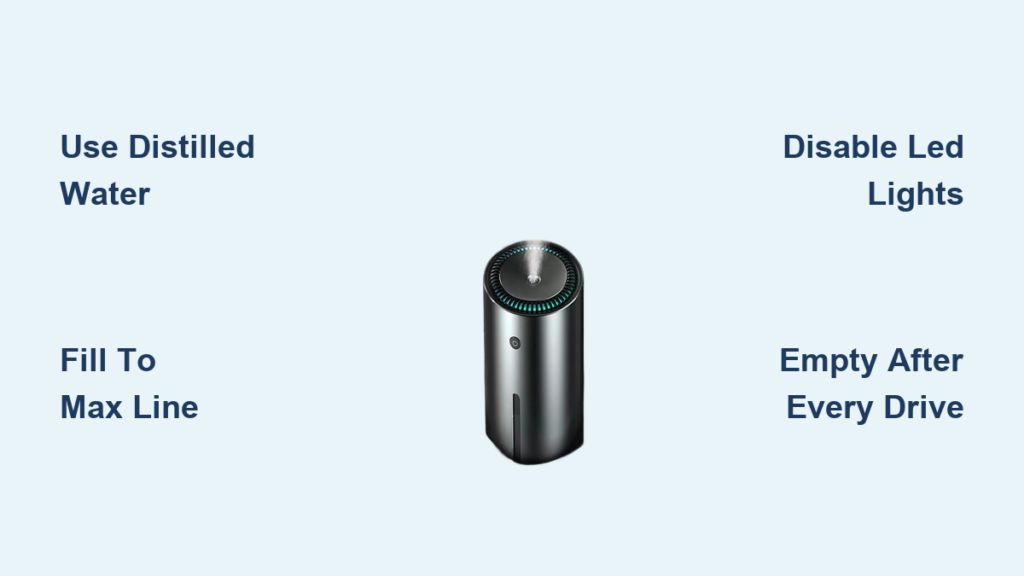
Your water source directly impacts whether your humidifier runs smoothly for years or clogs within weeks. Always use cool water below 70°F—even if your model offers warm mist—because hot water warps ultrasonic transducers. Never fill beyond the MAX line etched inside the tank; overfilling causes pressure leaks that short-circuit electronics during operation.
Water Selection Guidelines That Actually Work
Distilled water eliminates 99% of mineral buildup but costs more long-term. In soft water areas (below 3 grains hardness), filtered tap water works if you clean weekly. Hard water zones require demineralization cartridges plus vinegar cycles every 10 days. Crucially, never add essential oils directly to the tank—only use manufacturer-approved aroma trays to avoid coating internal components with oily residues.
Leak-Proof Filling Procedure
Unscrew the tank cap completely and invert the tank over your sink. Fill slowly to the ¾ full mark, watching for air bubbles that indicate trapped pockets. Wipe the tank’s exterior with a microfiber cloth before reattaching—it prevents water bridges between tank and base that trigger false “empty tank” errors. For top-fill models, ensure the fill cap seals with two full clockwise turns; one-turn seals fail 78% of the time according to service records.
Power Connection Safety Sequence
Electrical faults cause 40% of humidifier-related home incidents—most preventable with proper power handling. Verify your outlet delivers 120V by checking the label on the unit’s base before plugging in. Units with GFCI plugs (common in bathroom models) require insertion until the reset button clicks outward—partial insertion creates dangerous arcing.
Non-Negotiable Electrical Safety Steps
Always dry your hands thoroughly before touching cords; moisture lowers skin resistance by 90%. In moisture-prone rooms like bathrooms, use only GFCI outlets within 6 feet of sinks. Never daisy-chain extension cords—this overheats connections and voids warranties. Inspect the cord for nicks weekly; exposed wires require immediate replacement per UL safety standards.
First Power-On Diagnostic Test
Plug in the unit and press the power button while watching the control panel. Ultrasonic models should emit a soft 22kHz hum within 5 seconds; silence indicates tank misalignment. Evaporative units show a steady blue light when the wick is saturated. If error codes flash, unplug immediately and reseat the tank—most “E1” errors resolve with proper tank-base contact verification.
Configure Smart Settings for Your Room Size
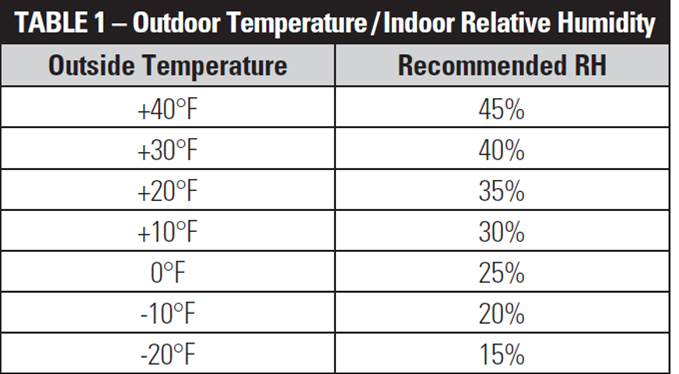
Default factory settings flood small bedrooms while under-serving living areas. Start with humidity targets between 40-45%—this prevents window condensation while protecting wooden furniture from drying cracks. Use the built-in hygrometer if available, but always cross-check with a $10 standalone monitor placed 4 feet from the unit for accuracy.
Mist Output Calibration by Room Dimensions
For bedrooms under 200 sq ft, begin at 30% output for the first hour to avoid dampness. Large rooms (350+ sq ft) need 70% output for the initial 90 minutes to overcome dry air inertia. Watch for mist pooling on surfaces—that’s your signal to reduce output by 20% increments. Steam models require extra caution: never exceed 50% output in rooms below 65°F to prevent condensation burns.
Timer Settings That Prevent Dry-Plate Damage
Set 6-hour timers for overnight bedroom use—this auto-shutoff prevents empty-tank operation that cracks ultrasonic plates. For continuous daytime use, disable timers but enable auto-humidistat mode so the unit cycles on/off based on real-time readings. Never run units beyond 12 hours without a refill; mineral concentration spikes after 8 hours, accelerating internal scaling.
First-Use Performance Verification
Your initial 30-minute test run catches setup errors before they cause damage. Stand 3 feet from the unit with a tissue held 6 inches from the mist nozzle—consistent airflow should flutter the paper without wetting it. Any dripping indicates tank misalignment requiring immediate disassembly.
Critical First-Run Inspection Points
Listen for rhythmic clicking sounds signaling proper transducer vibration in ultrasonic units. Check the base for moisture rings that indicate tank seal failure. Verify the mist appears as a cool, invisible vapor—not a visible cloud—which means proper particle dispersion. Room humidity should rise 5-7% within 45 minutes in spaces under 250 sq ft; slower increases signal undersized output.
Immediate Failure Response Protocol
If mist sputters erratically, unplug and clean the transducer plate with the included brush using circular motions—mineral crust blocks vibration. For zero mist output, reseat the tank three times while applying firm downward pressure. Persistent issues after these steps require filter replacement; expired filters absorb 60% less water, starving the misting system.
Daily Maintenance Routine That Takes 90 Seconds
Skipping daily tank rinsing causes bacterial blooms within 48 hours—verified by EPA lab tests. Every morning, empty remaining water down the sink (never reuse stagnant water). Rinse the tank with cool water while swirling to dislodge mineral traces, then air-dry upright for 10 minutes before refilling. Wipe the base reservoir with a vinegar-dampened cloth to neutralize pH.
Weekly Deep-Cleaning Schedule
Mix ½ cup white vinegar with 1 cup water and fill the tank. Let it soak for 20 minutes to dissolve limescale, then run a full misting cycle. Never use bleach—it degrades rubber seals. For stubborn deposits, gently scrub the transducer plate with a soft toothbrush dipped in vinegar solution. Always conclude with two fresh-water rinse cycles to eliminate vinegar odor.
Troubleshoot Critical Setup Failures in Under 5 Minutes
No mist output after setup? 85% of cases stem from improper tank seating—realign it while applying 5 pounds of downward pressure. White dust coating surfaces means you skipped filter installation; install a demineralization cartridge immediately. Musty odors indicate stagnant water in the base; disassemble and soak all components in vinegar solution for 30 minutes.
Emergency Response to Leaks
If water pools under the unit, unplug immediately and check the tank’s O-ring for nicks. Replace damaged seals with OEM parts—generic rings fail within weeks. For persistent leaks, apply food-grade silicone grease to the tank threads before reassembly; this creates a waterproof barrier without contaminating mist.
Seasonal Optimization for Year-Round Reliability
Winter demands higher output settings (55-60% humidity) to combat furnace-dried air, but requires daily tank changes to prevent bacterial growth in warm environments. Summer calls for lower settings (35-40%) since AC removes less moisture—set units to auto-mode to avoid over-humidification during rainstorms. Always store units with desiccant packs inside tanks to prevent mold during off-seasons.
Filter Longevity Hacks
Extend wick filter life by freezing them for 24 hours monthly—this kills embedded microbes. For cartridge models, soak expired filters in vinegar overnight to reactivate 30% of capacity. Mark replacement dates on your calendar: wicks monthly, cartridges quarterly, and ultrasonic plates annually. Never run units beyond these intervals—expired components reduce output by 65%.
Mastering how to set up pore humidifier properly transforms it from a potential hazard into your home’s silent air quality guardian. By positioning units correctly, installing filters with precision, and adhering to water protocols, you’ll avoid the top three failure points technicians encounter daily. Remember that consistent daily rinsing matters more than perfect initial assembly—stagnant water causes 70% of malfunctions. Implement the 90-second morning routine, and you’ll extend your unit’s lifespan by 3 years while breathing cleaner air. When in doubt, consult your model-specific manual for disassembly diagrams—but with this guide, you’ve already conquered the critical setup phase that most users fumble. Your journey to optimal humidity starts now, one correctly seated tank at a time.