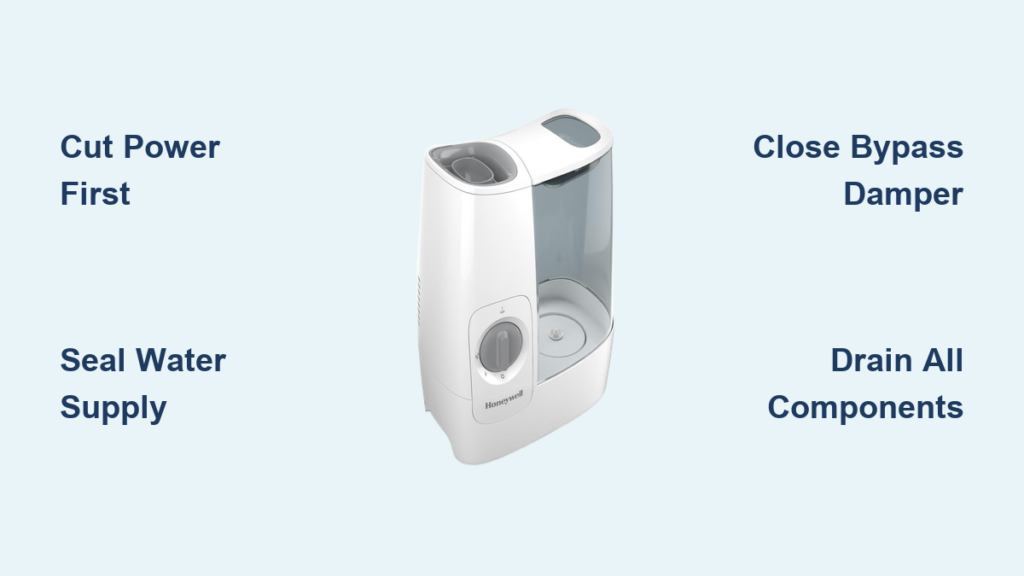
That persistent clicking from your humidistat means it’s time to shut down your Honeywell humidifier. Whether you’re storing it for summer or troubleshooting a malfunction, skipping critical shutdown steps risks water damage, mold growth, or costly repairs come fall. Most homeowners drain the tank but miss hidden water pockets in bypass dampers or residual moisture in fan-powered models—leading to musty odors and mineral buildup that cripples performance next season.
This guide delivers the exact shutdown sequence for every Honeywell model, including what manuals omit: why your furnace fan keeps running after power-off, how to fully drain bypass ducts, and preventing that dreaded “wet sock” smell. You’ll learn to shut down whole-house systems in 20 minutes flat and portable units without leaving a single drop behind. Follow these steps to avoid $300+ service calls when winter returns.
Identify Your Honeywell Model Before Shutting Down
Your shutdown steps depend entirely on whether you own a whole-house system connected to ductwork or a portable unit with a water tank. Mistaking one for the other risks flooding or electrical damage. Locate your model number immediately—it’s never where you expect.
Check these five spots for your model ID:
– Metal plate on the humidifier’s side (often near wiring)
– Under the cover around the water panel housing
– Back panel of portable units (HCM, HWM, or HEV series)
– Base of the humidistat control panel
– Original manual’s first page (if buried in a drawer)
Critical distinction: Whole-house models (HE220, HE260, HE360) have copper water lines and duct connections. Portables (HCM350, HWM700) feature removable tanks and sit on floors. Never proceed without confirming your type—wrong steps cause leaks.
Execute Whole-House Power-Down Without Leaks

Cut Power at the Source First
Never unplug while water flows. Locate the electrical disconnect—a gray box mounted on your furnace or humidifier housing. Flip the switch to “OFF” or pull the fuse. Verify power loss by checking if the humidistat screen goes dark. If not, shut off the circuit breaker labeled “humidifier.” Skipping this risks electrocution when handling water lines.
Seal Water Supply Completely
Trace the copper water line to find your saddle valve (a small T-shaped valve clamped onto the pipe). Turn it clockwise until snug—stop if resistance increases sharply to avoid cracking the valve. For quarter-turn ball valves (common in newer homes), rotate the handle 90 degrees until perpendicular to the pipe. No valve? Shut off the main house water supply temporarily. Test for leaks by placing a dry towel under connections.
Portable Unit Power-Off Protocol
- Unplug from the wall outlet—never pull the cord from the unit
- Remove all tanks (including hidden base reservoirs)
- Empty water by inverting tanks completely over a sink
- Blow air through tank openings to expel trapped droplets
Pro Tip: Run a dry paper towel through tank seams. If it comes out damp, residual moisture will grow mold in 48 hours.
Close Bypass Damper to Prevent Energy Waste
Leaving your bypass damper open forces your AC to cool air flowing through a dormant humidifier—wasting 15% of cooling energy. Locate the round metal handle on the duct connecting your humidifier to the furnace. Rotate it to “SUMMER” or “CLOSED” until the handle points away from the humidifier body. You should hear a soft clunk as it seats.
Why this fails: Mineral buildup jams dampers. If stiff, spray WD-40 on the pivot point and work it back-and-forth. Never force it—bent dampers cause $200 duct repairs. Verify closure by shining a flashlight into the duct—no light should pass through when closed.
Drain Every Drop From Water Components
Whole-House Unit Drainage Sequence
Residual water hides in three danger zones:
1. Water panel: Press thumb tabs to lift the cover, then pull out the blue/white panel. Hold it over a bucket—mineral-saturated water will drip for 60 seconds.
2. Reservoir tray: Tilt the unit 45 degrees toward the drain spout. Use a turkey baster for the last 2 oz trapped in corners.
3. Bypass duct: Place a towel under the duct elbow. Loosen the clamps slightly to drain pooled water before resealing.
Critical step: Air-dry components for 24 hours before storage. Stuck moisture breeds mold that clogs systems next season.
Portable Unit Deep Drain Checklist
- Base reservoir: Tip unit sideways and use a shop vac nozzle on low suction
- Wicking filters: Rinse under cool water until runoff runs clear (never hot water—it sets minerals)
- Hidden tanks: Check under control panels for secondary reservoirs in models like HWM900
- Drain holes: Clear clogs with a pipe cleaner wrapped in vinegar-soaked cotton
Warning: Never store filters damp. Stand them upright in indirect sunlight for 48 hours—they must be bone-dry to prevent mildew.
Handle Fan-Powered Models’ Hidden Risks

HE250, HE265, and HE365 series have a 60-second post-purge cycle after power-off. Don’t rush drainage—listen for the fan to stop completely. If it keeps running, your sail switch is stuck (a common failure point).
Drain hose maintenance:
– Disconnect the hose from the unit
– Flush with 50/50 white vinegar solution using a syringe
– Reattach while ensuring the hose has a downward slope (no U-bends trap water)
– Verify the drain trap has 1/2″ of water to block sewer gases
Pro Tip: Pour 1 cup of vinegar into the reservoir before shutdown. It dissolves mineral deposits overnight, making spring startup easier.
Prevent Accidental Fall Activation
Humidistat Settings That Avoid Winter Surprises
Turn dial humidistats to 15%—the lowest setting. Digital models (HM500, HM750) require pressing “OFF” for 3 seconds until the display flashes. Critical step: Disconnect outdoor temperature sensors and label wires with masking tape (“OUTDOOR SENSOR” + date). Reconnecting wrong wires in fall trips error codes.
Steam System Shutdown (HM500/HM750)
- Allow 30-minute cooldown—steam cylinders stay scalding hot
- Inspect the cylinder through the viewing window; replace if scaling exceeds 1/8″
- Drain the reverse osmosis tank by opening the drain valve
- Replace RO pre-filters if last changed over 12 months ago
Why this matters: Skipping cooldown cracks steam cylinders. One user reported a $475 replacement after touching a hot cylinder during shutdown.
Fix Shutdown Failures in 5 Minutes
Humidifier Won’t Stop Running
Diagnose in this order:
1. Check indoor humidity—if above setting, unit runs normally
2. Listen for solenoid “click” when humidistat activates (no click = faulty valve)
3. Shine a flashlight into the reservoir; a stuck float switch won’t drop when water drains
Emergency fix: Turn off the main water supply and call a technician. Forcing shutdown damages solenoids.
Water Leaks After Valve Closure
Immediate action:
– Close the main house water valve
– Check saddle valve orientation—it must be perpendicular to pipes
– Replace valves older than 5 years (they develop hairline cracks)
Pro Tip: Wrap Teflon tape clockwise around valve threads when reinstalling to prevent future leaks.
Pre-Storage Maintenance That Saves Spring Repairs

Water Panel Health Check
Hold the panel to light—if you can’t see shadows through it, mineral crust has blocked airflow. Replace immediately. Note the installation date on the frame; panels last 6-12 months. Never reuse a panel with brown streaks—that’s mold embedded in fibers.
Ductwork Inspection Checklist
- Seal bypass duct leaks with aluminum tape (not duct tape—it dries brittle)
- Lubricate damper pivot points with silicone spray
- Vacuum visible dust from duct interiors using a brush attachment
Time-saver: Take photos of wire connections before disassembly. One homeowner avoided a $150 service call by matching his fall photos during reactivation.
Store Components to Prevent Summer Damage
Whole-House Storage Protocol
Place silica gel packets inside the housing and leave the cover ajar 1 inch for airflow. Run your furnace fan for 24 hours post-shutdown to evaporate hidden moisture. Critical mistake: Never seal units in plastic bags—trapped humidity causes corrosion.
Portable Unit Storage Rules
- Store tanks and bases separately in breathable cotton bags
- Remove all batteries from digital controls
- Coil cords loosely with Velcro straps (tight wraps crack insulation)
- Keep in basements—not attics (heat warps plastic above 90°F)
Pro Tip: Store filters in sealed containers with desiccant packets. Moisture ruins them faster than time.
Fall Reactivation Checklist
Before winter hits, verify these 5 items:
1. Water lines for cracks (pressurize slowly to spot pinhole leaks)
2. Damper movement—should glide smoothly between positions
3. Electrical connections for white corrosion (clean with vinegar)
4. Water panel age—replace if installed over 6 months ago
5. Slow water valve opening while watching for drips
Final step: Run the system for 2 hours with windows open. If you smell burning dust, wipe heating elements with a dry cloth—never use water.
Final Note: Proper shutdown takes 20 minutes but prevents 90% of seasonal failures. Mark your calendar for October 1st to reverse these steps—your furnace will thank you when dry winter air hits. Remember: A single drop of trapped water causes more damage than skipping the entire process. Keep this guide handy for fall; you’ll save $200+ in avoidable service calls.