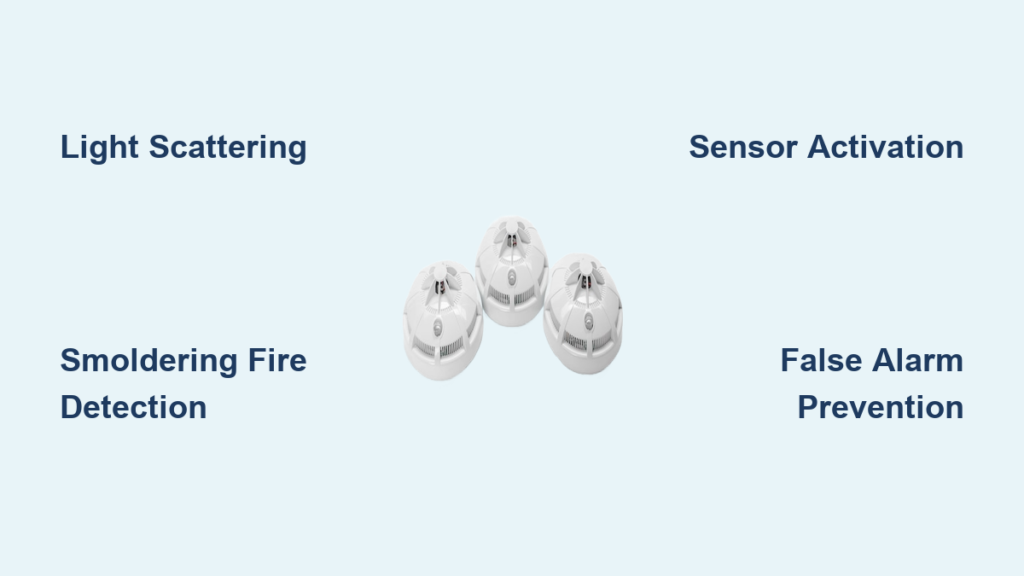
A photoelectric smoke detector is a life-saving device that uses light to spot smoke before flames appear. Unlike older ionization models, this technology excels at catching slow, smoldering fires that often start in furniture, bedding, or wiring. Many residential fires that turn deadly begin this way, producing thick smoke while people sleep. Understanding how a photoelectric smoke detector works helps you choose the right protection for your home.
This guide breaks down the science, components, and real-world performance of photoelectric detectors. You will learn how light scattering triggers the alarm, why this method excels at smoldering fires, and how it compares to ionization technology. We will also cover installation tips, maintenance requirements, and common false alarm triggers so you get the most reliable protection.
The Core Detection Mechanism Explained
How Light Scattering Activates the Alarm
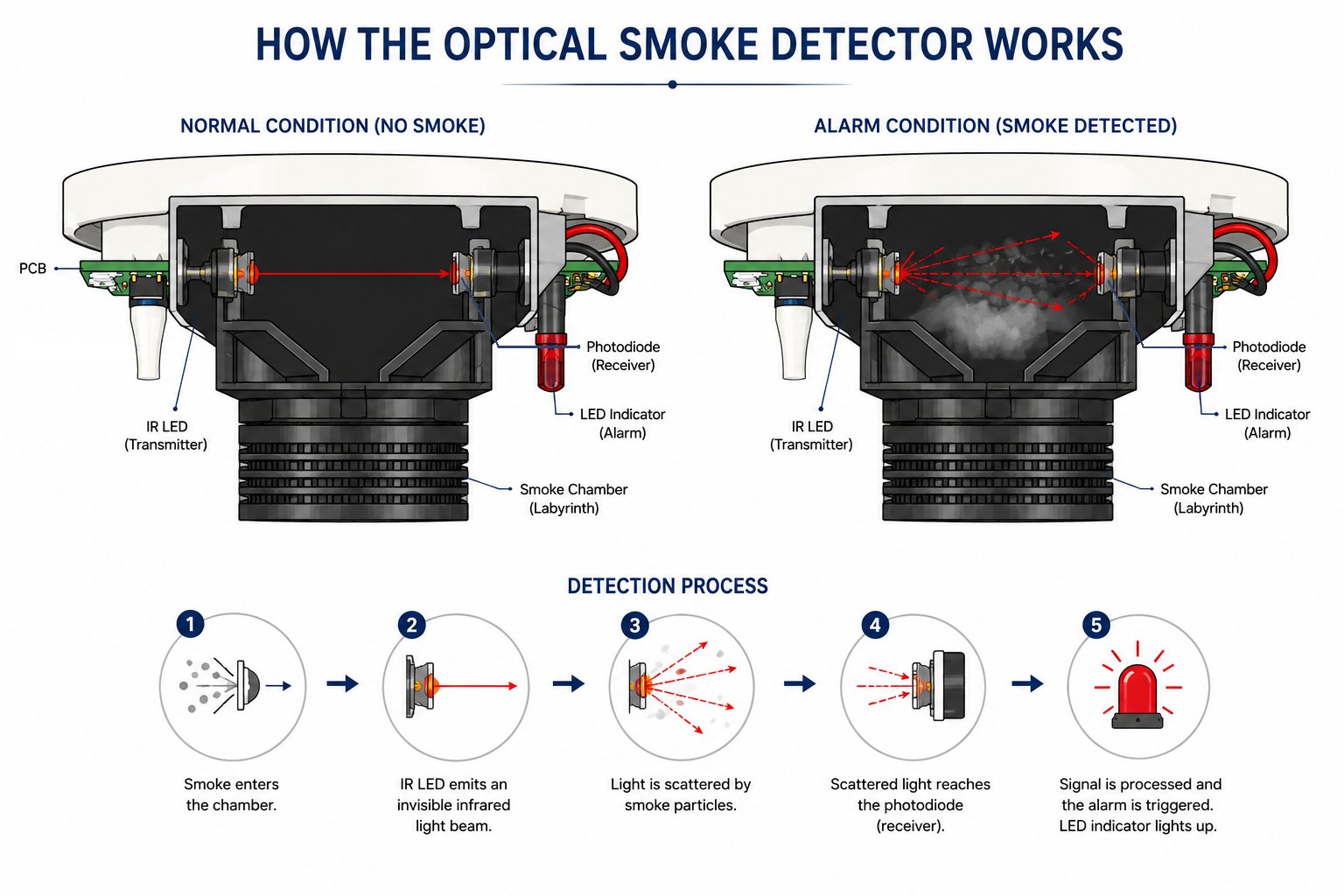
A photoelectric smoke detector works by sensing scattered light from smoke particles inside a sealed chamber. An LED projects a focused beam of light across a darkened space. A photoelectric sensor sits at an angle where the beam cannot reach it directly under normal conditions. When smoke enters, particles bounce the light in new directions. Some of that scattered light strikes the sensor, which converts it into an electrical signal. Once the signal crosses a set threshold, the alarm sounds.
This method is highly sensitive to larger particles common in smoldering fires. Whether caused by a cigarette in upholstery or overheated wiring, these fires create dense, visible smoke that reflects light effectively. The detection process runs silently in the background with no moving parts, which improves long-term reliability.
Key Components Inside the Sensing Chamber
Three main parts work together to detect smoke accurately:
- LED Light Source: Emits a steady beam of light into the chamber
- Photoelectric Sensor: Detects scattered light and produces an electrical response
- Optical Labyrinth: A maze-like structure that blocks outside light from causing false alarms
The LED typically runs on low power for extended battery life. The sensor, usually a photodiode, is calibrated to ignore minor light changes from dust or humidity. The optical labyrinth is critical because it ensures only light scattered by actual smoke reaches the sensor, keeping the system accurate in any lighting condition.
Normal Operation vs. Smoke Detection States
Clear Air: The Beam Stays Undetected
When the air inside the chamber is clean, the light beam travels straight through without striking the sensor. The sensor stays in darkness and sends out a minimal signal, confirming a safe condition. The circuit continuously monitors this baseline to ensure everything is functioning. This “dark chamber” design keeps the alarm quiet until real smoke disrupts the system.
Visual cue: If you could see inside, the chamber would appear dark except for the invisible beam passing across. The sensor sees nothing, exactly as intended.
Smoke Entry: Light Reaches the Sensor
Once smoke particles drift into the chamber, they interfere with the light beam. Through a process called light scattering, particles deflect the beam in multiple directions. Some of this scattered light bends into the sensor’s line of sight. Even a small amount of smoke produces a measurable jump in light intensity at the sensor.
The internal circuitry tracks how quickly light levels rise. If the increase is sharp and sustained, the system confirms a fire and triggers the alarm, usually at around 85 decibels. This fast response is especially valuable for smoldering fires, where large, light-colored smoke particles reflect light efficiently.
Why Photoelectric Detectors Excel at Smoldering Fires
Detecting Smoke Before Flames Appear
Photoelectric detectors are built to identify slow-burning, smoldering fires, the leading cause of fatal home fires. These fires can smolder for 20 minutes to several hours before bursting into flames. During that time, they release dense smoke filled with large, reflective particles, exactly what photoelectric sensors are designed to catch.
Compared to ionization detectors, photoelectric models can provide up to 30 minutes earlier warning in smoldering scenarios. That extra time often makes the difference during nighttime fires, when smoke inhalation can incapacitate occupants before they ever wake up.
Best Placement for Common Household Risks
Typical smoldering fire sources include:
- Cigarettes dropped on sofas, mattresses, or chairs
- Overheated electrical wiring hidden in walls
- Faulty appliances that smoke before igniting
- Flammable materials placed too close to heat sources
In all these cases, visible smoke appears long before open flames. Placing photoelectric detectors in bedrooms, hallways, and living rooms ensures early warning in the areas where people sleep and where smoldering fires most often begin.
Photoelectric vs. Ionization Smoke Detectors

How Each Technology Responds to Fires
Ionization smoke detectors use a tiny amount of radioactive material to charge air molecules between two plates, creating a steady electric current. When smoke enters, particles attach to ions and disrupt the current, triggering the alarm. These units respond fastest to small, invisible particles from flaming fires like paper or grease fires.
Photoelectric detectors work differently. They respond best to larger, visible particles from smoldering fires. They also tend to produce fewer nuisance alarms from cooking, making them ideal for bedrooms and living areas.
| Feature | Photoelectric | Ionization |
|---|---|---|
| Best at detecting | Smoldering fires | Flaming fires |
| Particle sensitivity | Large, visible particles | Small soot particles |
| Nuisance alarms near kitchens | Less common | More frequent |
| Recommended location | Bedrooms, hallways | Near kitchens, garages |
Why the NFPA Recommends Using Both
The National Fire Protection Association advises installing both technologies for complete protection. Since fires vary in how they start, relying on one type leaves dangerous gaps. You can meet this recommendation by installing separate units throughout the home or by choosing dual-sensor alarms that combine both methods in a single device. This layered approach ensures fast response whether a fire smolders or flames.
Advantages of Photoelectric Smoke Detectors
Early Warning That Saves Lives
The greatest benefit of a photoelectric smoke detector is its ability to provide early warning during the deadliest phase of a fire. Smoldering fires release toxic gases and heavy smoke while people sleep, and early detection dramatically improves survival odds. According to the NFPA, working smoke alarms cut the risk of dying in a fire by 55 percent.
Beyond saving lives, early detection also allows occupants to call for help and attempt to contain a fire before it spreads, reducing property damage.
Low Maintenance and Long-Term Reliability
Photoelectric detectors are simple to maintain and built for years of dependable service:
- Test the unit monthly using the test button
- Vacuum gently every six months to remove dust
- Replace batteries annually unless the unit is hardwired
- Replace the entire detector every 10 years
With no radioactive components, these detectors are also easier to dispose of responsibly. Their solid-state design means no moving parts to wear out, delivering consistent protection around the clock.
Limitations and Common Nuisance Alarm Triggers
Why Cooking and Steam Cause False Alerts
Because photoelectric sensors are highly sensitive to particles in the air, they can sometimes react to non-fire sources. Common triggers include:
- Steam from showers, kettles, or boiling pots
- Dust from home renovations or cleaning
- Aerosol sprays used near the unit
- Burnt toast or smoke from grilling
These particles scatter light just like real smoke, which can cause frustrating false alarms, especially if the detector is installed too close to a kitchen or bathroom.
How to Reduce False Alarms Safely
Never disable a smoke alarm to stop nuisance alerts. Removing the battery or covering the unit puts lives at serious risk. Instead, follow these steps:
- Relocate the detector at least 10 feet from cooking appliances
- Choose models with a hush button to silence alerts temporarily
- Use modern units with smart algorithms that filter out cooking fumes
Newer detectors use advanced signal processing to distinguish between brief cooking particles and sustained smoke from a real fire, greatly reducing unnecessary alarms.
Installation Best Practices for Maximum Protection
Where to Place Detectors in Your Home
Strategic placement ensures your detectors work when it matters most:
- Install one inside every bedroom
- Mount a unit outside each sleeping area
- Place detectors on every level, including the basement
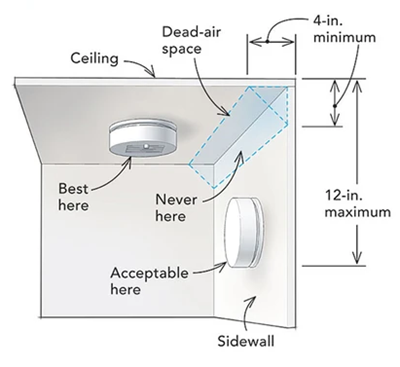
- Mount on ceilings or high on walls, avoiding corners
- Keep units at least 10 feet from cooking appliances
- Maintain 3 feet of distance from vents, fans, and windows
Ceiling mounting is ideal because smoke rises quickly. If you must mount on a wall, keep the top of the alarm 6 to 12 inches below the ceiling for proper airflow.
Testing and Replacement Guidelines
Follow these rules to keep your detectors in top condition:
- Test alarms once every month
- Clean units annually with compressed air
- Replace the entire detector every 10 years, even if it seems to work
- Keep maintenance records, especially in commercial buildings
Internal components degrade over time, and dust buildup reduces sensitivity. Sticking to a replacement schedule ensures your detector performs reliably when it counts.
The Future of Photoelectric Smoke Detection
Smarter Alarms With AI and Connectivity
Next-generation photoelectric detectors are being designed to solve common pain points and add new capabilities:
- AI-powered pattern recognition to reduce false alarms
- Better discrimination between cooking smoke and real fire smoke
- Wi-Fi connectivity for smartphone alerts when you are away
- Interlinking systems where all alarms sound together
- Voice notifications that guide occupants during evacuation
Some of these features are already available in high-end models, and adoption is growing as smart home technology becomes more common.
Research Focused on Speed and Accuracy
Ongoing research is targeting several key improvements:
- Faster response to both smoldering and flaming fires
- Better distinction between nuisance sources and real threats
- Long-term sensor stability to extend reliable service life
- Updated testing standards that reflect real-world home conditions
Standards organizations are revising protocols so that new alarms are evaluated under realistic fire scenarios, not just controlled lab environments.
Frequently Asked Questions About Photoelectric Smoke Detectors
What Is the Main Difference Between Photoelectric and Ionization Detectors?
Photoelectric detectors use light scattering to sense large smoke particles from smoldering fires. Ionization detectors use a radioactive source to detect small particles from fast-flaming fires. Each excels at detecting different fire types, which is why the NFPA recommends using both for full home protection.
How Often Should I Test My Photoelectric Smoke Detector?
You should test your detector once every month using the test button. Even if the alarm sounds during a test, the internal sensor could still be losing sensitivity, so regular testing is essential for reliable performance.
Where Should I Avoid Installing a Photoelectric Smoke Detector?
Avoid placing photoelectric detectors within 10 feet of cooking appliances, near bathrooms with heavy steam, or in direct airflow from heating and cooling vents. These locations increase the chance of false alarms and reduce detection accuracy.
Why Does My Photoelectric Alarm Go Off When I Cook?
Cooking releases steam, grease particles, and aerosols that scatter light just like real smoke. If your unit is too close to the kitchen, it cannot distinguish between cooking fumes and an actual fire. Moving the detector or using a model with a hush button can solve the problem.
How Long Do Photoelectric Smoke Detectors Last?
Most photoelectric smoke detectors have a service life of 10 years. After that, internal components degrade and sensitivity drops. Replace the entire unit on schedule, even if it still seems to function during tests.
Do I Need Both Photoelectric and Ionization Detectors in My Home?
The NFPA strongly recommends using both types, or a dual-sensor unit, because no single technology can detect every type of fire quickly. Combining them ensures you are protected against both smoldering and flaming fire scenarios.
Key Takeaways for Choosing a Photoelectric Smoke Detector
A photoelectric smoke detector works by using a light beam and a sensor inside a sealed chamber. When smoke enters, particles scatter the light toward the sensor and trigger the alarm. This method is especially fast at detecting smoldering fires, the most common cause of fatal home fires.
For the best protection, install photoelectric detectors in every bedroom, hallway, and living area, and combine them with ionization units or a dual-sensor model. Test your alarms monthly, clean them annually, and replace them every 10 years. Start by checking the detectors you already have. Confirm they are photoelectric, less than a decade old, and installed in the right locations. If not, upgrading today could be the most important safety decision you make this year.